Wireless 1D / 2D QR barcode scanner with stand and onboard memory, 2.4 GHz USB receiver and Bluetooth 5.0, HDWR HD2600A
GTIN: 5906935203040 · SKU: HD2600A
Table of contents
Specifications
- Processor: ARM Cortex 32-bit
- Light source: 650 nm ±10 nm LED
- Sensor: CMOS
- Scanning method: manual (push button) or automatic (proximity-triggered)
- Scan confirmation: LED indicator and beep
- Wireless communication: Bluetooth 5.0 and 2.4 GHz radio
- Wireless range: up to 100 m in open space (2.4 GHz), up to 15 m (Bluetooth)
- Interface: USB, Virtual COM
- Onboard memory: up to 50,000 codes
- Battery capacity: 1800 mAh
- Charging voltage: 5 V
- Charging current: 1 A
- Charging time: 4 hours
- Standby time: 30 days
- Charging cable length: 100 cm
- Device dimensions: 14.5 × 5 × 7.5 cm
- Receiver dimensions: 2 × 1.5 × 0.5 cm
- Stand dimensions: 17.5 × 12 × 18.5 cm
- Package dimensions: 18.5 × 12.5 × 8.5 cm
- Device weight: 240 g
- Weight with packaging: 360 g
- Operating temperature: 0 to 40 °C
- Storage temperature: −40 to 60 °C
- Operating humidity: 5 to 95%
- Storage humidity: 5 to 95%
- Drop resistance: up to 1.5 m
- Readable 1D codes: CodaBar, Code 11, Code 32, Code 39, Code 93, Code 128, IATA 2 of 5, Interleaved 2 of 5 (ITF), GS1 DataBar, HongKong 2 of 5, Matrix 2 of 5, MSI Plessey, NEC 2 of 5, Pharmacode Plessey, Straight 2 of 5, Telepen, Trioptic, UPC/EAN/JAN, Codablock F, microPDF, GS1 Composite
- Readable 2D codes: PDF417, Micro PDF417, QR Code, Micro QR, DataMatrix, Maxicode
Set contents
- HDWR HD2600A QR and barcode scanner
- Scanner stand
- USB receiver (2.4 GHz dongle)
- USB charging cable
- User manual
Features
- 1D and 2D scanning: a CMOS sensor reads classic 1D barcodes as well as QR Code, DataMatrix, PDF417 and other 2D codes — from paper labels and from LCD, LED and OLED screens, including phone displays
- Dual wireless: a bundled 2.4 GHz USB receiver (up to 100 m) plus built-in Bluetooth 5.0 (up to 15 m, HID / SPP / BLE profiles) for direct pairing with phones, tablets and laptops
- Onboard memory (storage mode): store thousands of codes while out of range and upload them later in one batch
- Automatic scanning: combined with the included stand, the proximity-triggered automatic mode makes the scanner almost hands-free
- Virtual COM port: output over a 2.4 GHz wireless COM port for software that expects a serial device
- Highly configurable: keyboard layout in 22 languages, iOS keyboard, end mark, transmission speed and delay, hide characters, prefix/suffix and an ASCII character table
- Power management: standby timer and optional vibration feedback
Configuration codes
To change scanner settings, scan the barcode below directly with the HD2600A.
💡 Tip: print this page ("Download this page as PDF" button above) to keep the codes at hand during configuration.
Restore factory defaults
If the scanner does not behave as expected, scan the code below to restore all settings to their default values:

Version information (output the firmware version):

Battery level (output the current battery charge):

Scanning mode
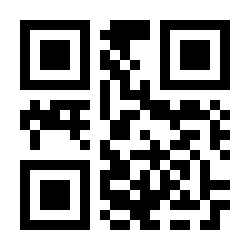
Automatic mode (the scanner reads codes on proximity, without pressing the button — ideal together with the stand). To return to manual mode, press the scan button; automatic mode is also restored after the scanner sleeps and wakes up:
Connection and pairing
The HD2600A connects to the host in several ways. By default the bundled 2.4 GHz USB receiver works as a keyboard (HID) — just plug it in.
2.4 GHz
2.4 GHz mode (pair with the USB receiver):

Enter pairing mode:

2.4 GHz Virtual COM port
Use this when your software expects a serial (COM) device: scan COM port mode, then Enter pairing mode, plug in the receiver — a COM port is created on the host.
COM port mode:

Bluetooth
Bluetooth HID mode (Bluetooth keyboard):

Bluetooth SPP mode (serial port profile):

Bluetooth BLE mode (Bluetooth Low Energy):

Operating modes
Normal mode (real-time — each scan is transmitted to the host immediately):

Storage mode (scans are saved to onboard memory; upload them later):

Total amount of stored data:

Data transmission (data is kept in memory afterwards):

Clear data (upload the data first):

End mark
Character automatically appended after each scanned code.
CR (Carriage Return):

LF (Line Feed):

CR + LF:

Remove CR + LF (no end mark):

TAB:

Transmission speed and delay
Add a delay or slow the transmission down if the host receives data too fast to keep up.
Enable 2.4 GHz delay:

Disable 2.4 GHz delay:

Speed — Fast:

Speed — Middle:

Speed — Slow:

Speed — Super slow:

Buzzer and vibration
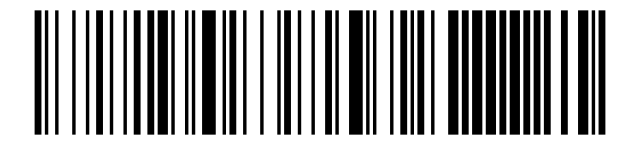
Buzzer off:

Buzzer on:

Vibration off (optional):

Vibration on (optional):
Letter case
Convert to lowercase:

Convert to uppercase:

No case change:

Swap upper ↔ lower case:

iOS keyboard
Control the on-screen keyboard on iOS devices.
Show / hide the iOS keyboard:

Double-click to pull up the iOS keyboard:

Double-click to hide the iOS keyboard:

Standby timer
Standby after 1 minute:

Standby after 5 minutes:

Standby after 10 minutes:

Standby after 30 minutes:

Never enter standby:

Standby immediately:

Hide leading / trailing characters
Scan Hide leading characters (prefix) or Hide trailing characters (suffix), then scan one count code below. Re-scan the same prefix / suffix code to cancel hiding.
Hide leading characters (prefix):

Hide trailing characters (suffix):

Show all 16 character-count codes (hide 1–16)
Hide 1:

Hide 2:

Hide 3:

Hide 4:

Hide 5:

Hide 6:

Hide 7:

Hide 8:

Hide 9:

Hide 10:

Hide 11:

Hide 12:

Hide 13:

Hide 14:

Hide 15:

Hide 16:

Keyboard layout
Set the scanner's keyboard layout to match the host operating system.
Show all 22 keyboard layouts
English (USA):

German:

French:

Spanish:

Italian:

Japanese:

International universal keyboard:

Belgian:

Portuguese:

English (UK):

Portuguese (Brazil):

French (Switzerland):

Russian:

Czech:

French (Canada):

Hungarian:

Polish:

Sweden / Finland:

Spanish (Mexico):
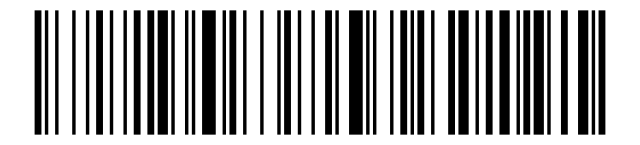
Argentine (Latin America):

Norwegian:

German (Switzerland):

Add prefix / suffix
To add a prefix or suffix made of one or more characters before / after every scanned barcode:
- Scan Allow for prefix adding (or Allow for suffix adding).
- Scan one or more character codes from the character table below.
- To cancel, scan Allow for prefix adding (or Allow for suffix adding) once more.
Allow for prefix adding:

Allow for suffix adding:

Character table
Each code below represents a single character used to compose prefixes or suffixes. Scan them after Allow for prefix / suffix adding above.
Show all 127 character codes (control characters and printable ASCII)
Control characters
SOH (0x01):

STX (0x02):

ETX (0x03):

EOT (0x04):

ENQ (0x05):

ACK (0x06):

BEL (0x07):

BS (0x08):

HT (0x09):

LF (0x0A):

VT (0x0B):

FF (0x0C):

CR (0x0D):

SO (0x0E):

SI (0x0F):

DLE (0x10):

DC1 (0x11):

DC2 (0x12):

DC3 (0x13):

DC4 (0x14):

NAK (0x15):

SYN (0x16):

ETB (0x17):

CAN (0x18):

EM (0x19):

SUB (0x1A):

ESC (0x1B):

FS (0x1C):

GS (0x1D):

RS (0x1E):

US (0x1F):

Printable ASCII
Space:

!:

":

#:

$:

%:

&:

':

(:

):

*:

+:

,:

-:

.:

/:

0:

1:

2:

3:

4:

5:

6:

7:

8:

9:

::

;:

<:

=:

>:

?:

@:

A:

B:

C:

D:

E:

F:

G:

H:

I:

J:

K:

L:

M:

N:

O:

P:

Q:

R:

S:

T:

U:

V:

W:

X:

Y:

Z:

[:

\:

]:

^:

_:

`:

a:

b:

c:

d:

e:

f:

g:

h:

i:

j:

k:

l:

m:

n:

o:

p:

q:

r:

s:

t:

u:

v:

w:

x:

y:

z:

{:

|:

}:

~:

Delete:

Frequently asked questions
What types of codes can the HD2600A scan?
Can I use the HD2600A without a constant connection to a computer?
What wireless technologies does the scanner use?
Can the scanner read codes from phone screens?
Does the scanner support automatic scanning mode?
Downloads
Original manufacturer PDF manuals kept available as a legacy reference. Everything from them is already covered on this page — use the PDFs only if you need an offline copy.